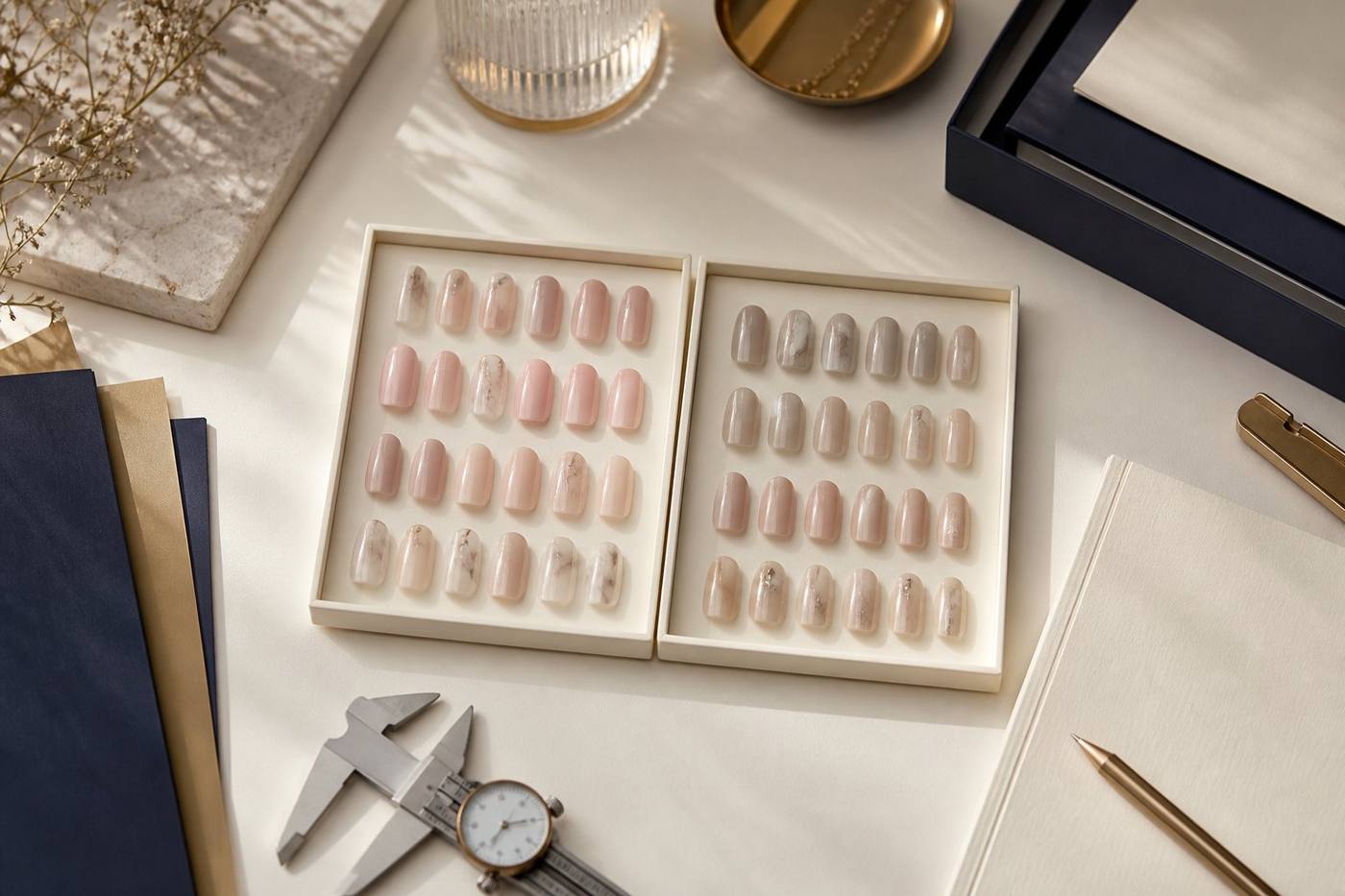
Small brands do not need a perfect forecast to begin. They need to understand which decisions affect the minimum order, the sample route and the production calendar.
01
MOQ is not one number
A supplier may have one MOQ for the nail product, another for a particular colour or decoration, and a third for branded packaging. A box printer may have a higher threshold than the product itself. Ask for these separately. This gives a new brand more options: it may begin with a simple, unbranded outer package, or combine several styles into one packaging run when that makes commercial sense.
02
A sample is not a miniature bulk order
The purpose of a sample is to reduce uncertainty before production. It can confirm whether a shape looks right, whether colours translate from a reference image, how decorations sit, and whether the set feels coherent in its packaging. Sample fees and lead times vary with the level of custom work. Treat them as part of product development, not simply as a unit-cost preview.
03
Lead time starts after decisions are made
A quoted production timeline usually begins only after the design, set contents, packaging artwork and sample approval are clear. The calendar can extend when a brand changes colours, finishes or packaging after sampling. A realistic plan leaves room for supplier questions, sample transit, internal review and one revision if the first sample is not ready.
04
Compare suppliers against the same brief
If one supplier is quoted against a finished 24-piece set with a branded box and another is quoted against loose nail tips, the prices cannot be compared. Give each candidate the same essentials: product reference, intended set contents, packaging need, target market, estimated quantity and expected timing. The result is a useful comparison rather than a collection of unrelated numbers.
05
Use a simple decision sheet
For each supplier option, record the product direction, MOQ, sample cost, estimated sample time, production time, customisation limits and any unanswered questions. Keep actual photos or videos beside the notes. It becomes much easier to explain a recommendation to a partner, investor or team when the trade-offs are visible in one place.
The best early question is not “What is your MOQ?” but “What is the MOQ for this product, this finish and this packaging plan?” It produces a more useful answer.
Frequently asked questions
Questions worth resolving before you plan MOQ and lead time.
Is press-on nail MOQ a single number?
No. A supplier can have separate MOQs for the base nail product, a specific colour or decoration, and branded packaging, so ask for each threshold individually rather than assuming one number covers the whole set.
What is a press-on nail sample actually for?
A sample exists to reduce uncertainty before production, confirming shape, colour accuracy, how decorations sit and whether the set feels coherent in its packaging, rather than acting as a miniature bulk order or a unit-cost preview.
When does press-on nail production lead time actually start?
A quoted production timeline usually begins only once the design, set contents, packaging artwork and sample are approved, so changing colours or packaging after sampling extends the calendar from that later starting point.