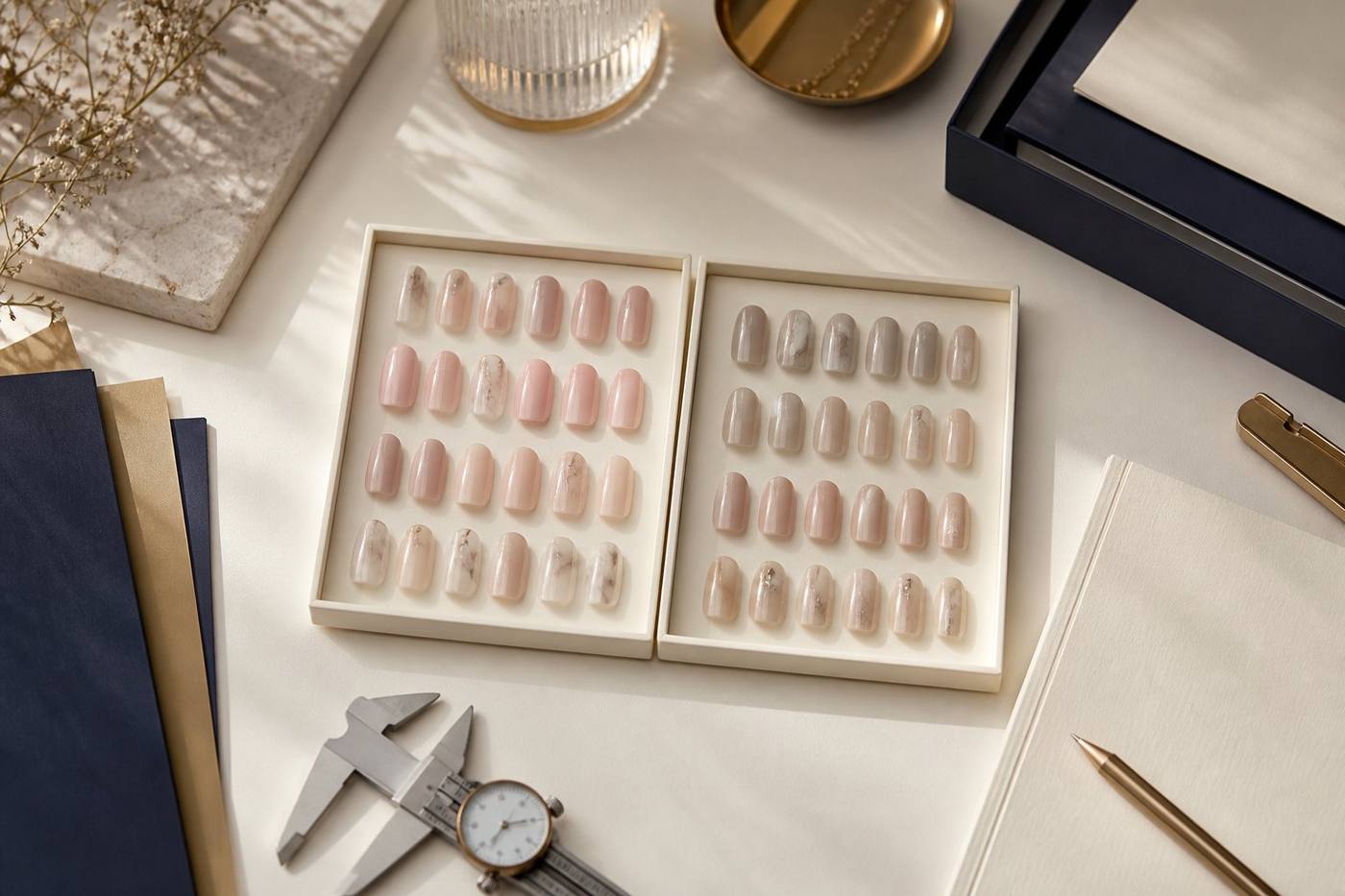
The first task is not finding the lowest price. It is turning a visual idea into enough clear decisions that a supplier can make, quote and sample the right product.
Step 01
Start with a product brief, not a product link
A link can be useful for inspiration, but it is not enough for a supplier to quote accurately. Write down the nail shape, length, finish, colour family, decoration level, set quantity, target market and rough target price. If you only have reference images, say which details matter and which are flexible. A supplier can then tell you what is feasible to sample rather than simply saying yes to everything.
Step 02
Separate the nail product from the full customer set
A press-on nail collection is usually more than the tips. Think through sizes, nail tabs or glue, prep pads, file, wooden stick, instructions, display card and outer box. Brands often compare nail prices first and discover later that the accessories and packaging have changed the total cost. Ask for the full set configuration early so each option can be compared fairly.
Step 03
Ask practical supplier questions before paying for samples
A promising product photo does not answer the questions that affect a launch. Request current product videos, material information, MOQ for nails and packaging, sample fee, sample lead time, production lead time, customisation limits and export handover experience. The reply itself is useful evidence: clear answers, actual footage and reasonable follow-up questions are usually more valuable than a beautifully designed catalogue.
Step 04
Treat the sample as a decision tool
A sample should help you test what a product will feel like for the customer. Review shape, fit, finish, colour consistency, decoration attachment, edge quality, glue or tabs, packaging fit and the instructions. If you are comparing two options, put the same brief in front of both suppliers. That makes the decision about the product and execution, not about who wrote the fastest message.
Step 05
Confirm the details in writing before production
Before any bulk order, consolidate the approved design, set contents, sizes, materials where relevant, packaging artwork, quantity, lead time, quality expectations and shipping handover. Keep the record simple enough that everyone can read it. The purpose is not paperwork for its own sake; it is to prevent a small assumption from becoming a large production problem.
Step 06
Where a sourcing contact adds value
For an independent brand, it can be difficult to compare suppliers from another country while also building a collection, preparing launch content and serving customers. A China-based sourcing contact can help ask the questions, organise the replies, compare sample options and keep the product, packaging and order milestones in one conversation. The decision remains yours; the process becomes easier to see.
A good sourcing process does not remove every risk. It makes the important risks visible early: unclear specifications, mismatched sample expectations, packaging assumptions and communication gaps.
Frequently asked questions
Questions to resolve before the next sample.
Is a reference image or product link enough to get an accurate China sourcing quote?
No. Write down the nail shape, length, finish, colour family, decoration level, set quantity, target market and rough target price, and flag which details are flexible so a supplier can tell you what's actually feasible.
Is a press-on nail collection just the nail tips?
No. Think through sizes, nail tabs or glue, prep pads, file, wooden stick, instructions, display card and outer box early, since comparing nail prices alone often hides how much accessories and packaging add to the total cost.
What should I confirm in writing before placing a bulk order?
Consolidate the approved design, set contents, sizes, materials where relevant, packaging artwork, quantity, lead time, quality expectations and shipping handover into one simple, readable record before production.